Topic
Understanding Hormones
If you’ve found yourself feeling more tired, foggy, emotional, achy, or simply not quite like yourself, you are not imagining it — and you are certainly not broken.
Midlife is a time of powerful hormonal change. Understanding what’s happening in your body is often the first and most relieving step toward feeling better.
Hormones influence everything:
your energy, sleep, mood, weight, temperature regulation, digestion, muscle mass, motivation, and even how resilient you feel emotionally. When they shift, it can feel as though the rules have suddenly changed.
This page is here to help you make sense of that change — with clarity, compassion, and practical understanding.

What Are Hormones, Really?
Hormones are chemical messengers.
They travel through your bloodstream, delivering instructions to different systems in your body — telling them when to wake up, slow down, repair, release, or restore.
In your reproductive years, hormones like oestrogen, progesterone, and testosterone follow fairly predictable patterns. At midlife, those patterns change — not gradually, but often erratically.
This is why symptoms can feel confusing, inconsistent, or even alarming.
What Is Perimenopause?
Perimenopause is the transition phase leading up to menopause.
It can begin anywhere from your late 30s to early 50s — and often much earlier than women expect.
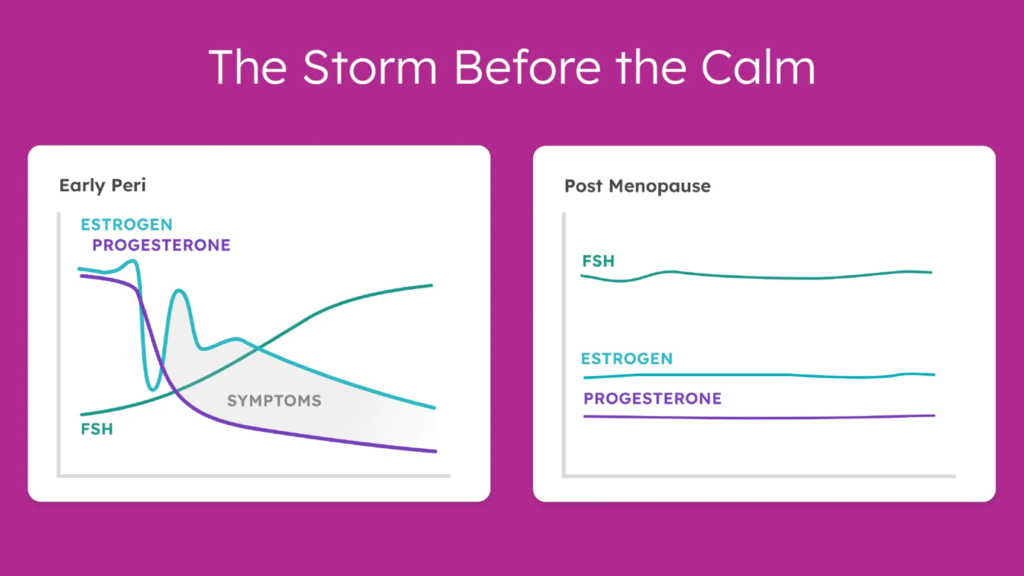
This stage is defined by hormonal fluctuation, not hormone loss.
Oestrogen and progesterone don’t simply decline — they rise and fall unpredictably. One month you may feel fine. The next, completely different.
Common experiences during perimenopause include:
- Fatigue that doesn’t match your effort
- Sleep disruption (especially early waking)
- Anxiety or low mood
- Weight gain around the middle
- Brain fog or forgetfulness
- Changes in menstrual cycles
- Hot flushes or night sweats
- Reduced stress tolerance
Many women are told they are “too young” for this stage. In reality, perimenopause is often the longest and most challenging hormonal transition.
What Is Menopause?
Menopause is officially defined as the point when you have gone 12 consecutive months without a menstrual period.
This is not the beginning of the journey — it is a milestone within it.
By this stage, oestrogen and progesterone levels have settled at a new, lower baseline. Some symptoms ease, while others may continue if the body hasn’t been supported through the transition.
Menopause is not an ending.
It is a shift — into a new hormonal landscape that requires different strategies, not less care.
Why Symptoms Can Feel So Intense
Hormonal change doesn’t happen in isolation.
At midlife, your body is also navigating:
- Increased stress load
- Poor sleep recovery
- Blood sugar instability
- Muscle loss if strength isn’t prioritised
- Gut and immune shifts
- Nervous system overload
This is why “just eating less” or “pushing harder” often backfires.
What worked in your 30s may no longer support you — and that’s not failure. It’s biology.
The Reframe: You’re Not Failing — Your Body Is Asking for Support
One of the most damaging myths about menopause is that suffering is inevitable.
It isn’t.
With the right knowledge, nourishment, movement, rest, and mindset, this phase can become one of strength, clarity, and renewed self-connection.
Understanding your hormones allows you to:
- Work with your body instead of against it
- Make sense of symptoms without fear
- Choose support options confidently
- Build habits that restore energy and resilience
This is the foundation of everything we do inside Your Menopause Balance.